Contact Seller
M C Taylor Clocks
Tel01202429718Please quote Antiques Atlas.

 Lantern Clock by Mercer
 Late 19th century German lantern clock
 18th Century Lantern Clock by Windmills & Bennet
 1st Period English Lantern, House or Chamber Clock
 An English Lantern Clock by Peter Closon, London.
 Northern English Lantern Clock by John Waller
 English Lantern Clock Attributed to James Ogden Sr
 English Lantern with Verge Escapement & Alarm
 A Small Lantern Clock
 Lantern Clock Twin Train Circa 1900’s
 1937 George the V1 Coronation Lantern Clock
 17th-Century Lantern Clock by Ignatius Huggeford
Non UK callers :
+44 1202429718
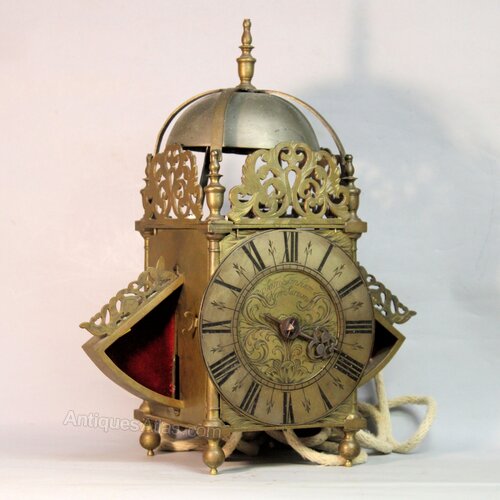
A 3rd Period, Winged, English Lantern Clock


The finest and most original example that I have ever seen.
The 30 hour duration movement with Verge escapement and a short internal pendulum that swings between the wheel trains. The pendulum bob is of a well-shaped, 3 dimensional brass 'anchor' that swings through the side doors and can be seen within the 'wings'. The un-colleted wheels are mounted on tapered iron arbors that are pivoted between 2 pairs of upright narrow plates, 3 of which are of cruciform shape. The striking release arbor that runs from front to back has a large central 'stirrup' to give clearance for the pendulum. The movement has countwheel striking the hours on the top-mounted cast bell that is hung from a decorative cross strap that has a central urn finial and sprung within the further 4, matching urn corner finials. The wheel trains are rope driven by the Huygens 'endless cord' method.
The tapered Doric style corner pillars have shaped ball feet. The 3 cast brass top frets are well executed and the front one is nicely engraved. The 6 1/4" diameter chapter ring has an outer ring, Roman hour numerals, a double ringed and divided quarter track to the inner and there and 'wheat stalk' half hour marks. The dial plate has engraved corners and centre that bears a tulip floral design with the upper area showing the maker's signature of "Sam Tinham. New Sarum". The cut iron hand has a scrolled end and a tail for time setting. The back plate is iron and the brass side doors carry exceptionally well made 'wings' with red cloth backing and engraved top frets.
Samuel Tinham is recorded as working about c.1690. He married Mary Prater on 13th November 1704 at St. Edmund's church in Salisbury (which is still there). It seems that he was also buried there on 5th July 1721. Signed lantern and longcase clocks by him are known.
This lantern clock is of extremely high quality workmanship, it is substantially made and is also of very rare originality. I cannot recall ever seeing such a perfect and original example. It is widely believed that 'wings' were exclusively Victorian additions but no one knows for sure, these may well be if I am correct in my assumptions. Oddly, there is no evidence that this clock was ever fitted with a 'Hoop and spikes' for wall hanging. There are a couple of filled holes in the top plate which don't appear to correspond to anything. I think it fair to assume that this clock was made to be placed within a tall case (this would indicate that the wings and anchor are later additions because they wouldn't be seen). It now sits very handsomely upon a purpose built, medium oak bracket and has the advantage of sitting right against a wall.
SellerM C Taylor Clocks
View all stock from
M C Taylor Clocks

 995 Christchurch Road
Bournemouth
Dorset
England
BH7 6BB
Tel : 01202429718
Non UK callers : +44 1202429718
Get directions to M C Taylor Clocks
The 30 hour duration movement with Verge escapement and a short internal pendulum that swings between the wheel trains. The pendulum bob is of a well-shaped, 3 dimensional brass 'anchor' that swings through the side doors and can be seen within the 'wings'. The un-colleted wheels are mounted on tapered iron arbors that are pivoted between 2 pairs of upright narrow plates, 3 of which are of cruciform shape. The striking release arbor that runs from front to back has a large central 'stirrup' to give clearance for the pendulum. The movement has countwheel striking the hours on the top-mounted cast bell that is hung from a decorative cross strap that has a central urn finial and sprung within the further 4, matching urn corner finials. The wheel trains are rope driven by the Huygens 'endless cord' method.
The tapered Doric style corner pillars have shaped ball feet. The 3 cast brass top frets are well executed and the front one is nicely engraved. The 6 1/4" diameter chapter ring has an outer ring, Roman hour numerals, a double ringed and divided quarter track to the inner and there and 'wheat stalk' half hour marks. The dial plate has engraved corners and centre that bears a tulip floral design with the upper area showing the maker's signature of "Sam Tinham. New Sarum". The cut iron hand has a scrolled end and a tail for time setting. The back plate is iron and the brass side doors carry exceptionally well made 'wings' with red cloth backing and engraved top frets.
Samuel Tinham is recorded as working about c.1690. He married Mary Prater on 13th November 1704 at St. Edmund's church in Salisbury (which is still there). It seems that he was also buried there on 5th July 1721. Signed lantern and longcase clocks by him are known.
This lantern clock is of extremely high quality workmanship, it is substantially made and is also of very rare originality. I cannot recall ever seeing such a perfect and original example. It is widely believed that 'wings' were exclusively Victorian additions but no one knows for sure, these may well be if I am correct in my assumptions. Oddly, there is no evidence that this clock was ever fitted with a 'Hoop and spikes' for wall hanging. There are a couple of filled holes in the top plate which don't appear to correspond to anything. I think it fair to assume that this clock was made to be placed within a tall case (this would indicate that the wings and anchor are later additions because they wouldn't be seen). It now sits very handsomely upon a purpose built, medium oak bracket and has the advantage of sitting right against a wall.
Price
Click here to message the seller The price has been listed in British Pounds.
Conversion rates as of 21/MAY/2026. Euro & Dollar prices will vary and should only be used as a guide.
Always confirm final price with dealer. To include the above advised work.
Dimensions14 1/2" high x 5 3/4" wide x 5 3/4" deep (top and bottom plate size).
Category Antique Clocks
Date 1690
17th Century Antiques Material Brass and Iron
Origin English
Condition Physically exceptional. In good, working order with little or no wear. It has been well managed and maintained throughout its life but has a question mark regarding the wings and pendulum. All is totally original even down to the square headed screws. The engraving is wax-filled and the chapter ring shows faint traces of silvering. The movement contains rope dust and will benefit from a non-cosmetic clean and lubrication. The brass has age-coloured to a lovely bronze colour which can be enhanced and protected with a good wax polishing. The steel parts are in particularly good condition and have not rusted. There is absolutely no evidence of this clock ever falling from the wall, which is extremely rare and serves to strengthen my suspicion that it was made to be placed in a tall case.
Item code as1197a127 / AA17532
Status For Sale
£9500.00 
$12741.40
€10990.55

$12741.40

€10990.55

Looking to Buy?
Arrange a final price and delivery details directly with the dealerClick here to message the seller
Conversion rates as of 21/MAY/2026. Euro & Dollar prices will vary and should only be used as a guide.
Always confirm final price with dealer. To include the above advised work.
View all stock from
M C Taylor Clocks
 995 Christchurch Road
Bournemouth
Dorset
England
BH7 6BB
Tel : 01202429718
Non UK callers : +44 1202429718
Get directions to M C Taylor Clocks
You may also be interested in
 Lantern Clock by Mercer
 Late 19th century German lantern clock
 18th Century Lantern Clock by Windmills & Bennet
 1st Period English Lantern, House or Chamber Clock
 An English Lantern Clock by Peter Closon, London.
 Northern English Lantern Clock by John Waller
 English Lantern Clock Attributed to James Ogden Sr
 English Lantern with Verge Escapement & Alarm
 A Small Lantern Clock
 Lantern Clock Twin Train Circa 1900’s
 1937 George the V1 Coronation Lantern Clock
 17th-Century Lantern Clock by Ignatius Huggeford