Contact Seller
Harveys Antiques
Tel01993 706 501Please quote Antiques Atlas.


 Antique 16 Seater Three Pedestal Dining Table
 William IV Rosewood Breakfast Dining Table c.1835
 Super C18th Oak Dropleaf Dining Table
 Victorian Mahogany Extending Dining Table
 Regency Style Twin Pillar Dining Table
 William IV Mahogany Seat Extending Dining Table
 Victorian Mahogany Telescopic Dining Table
 Regency Satinwood Pembroke/Supper table
 Georgian Mahogany Drop Leaf Dining Table
 Epstein Art Deco Walnut Dining Table,chairs C 1930
 Howard & Son's Leather Top Library Dining Table
 Art Deco Dining suite by H&L Epstein 1930’s.
Non UK callers :
+44 1993 706 501
Gillows Patent Mahogany Extending Dining Table


No: 11167
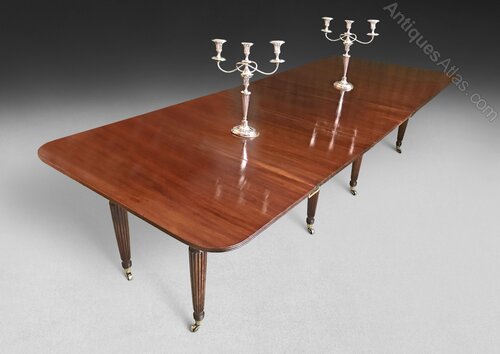
An extremely rare and important George III Period Mahogany Extending Dining Table, patented by Gillows in 1800. This unique design features a rotating centre leaf, allowing it to be used as a serving or side table when not in use for dining. The original design is in the Gillows work books and is the forerunner of the Imperial Dining Table which superseded this example by 1805. It has retained all 5 original leaves and is a spectacular run of solid mahogany when opened, measuring 122”, 310cm x 46”, 117cm. The telescopic bearers are supported on 8 ring turned, tapered and reeded legs terminating in Brass cups and castors.
Height: 29.25”, 74 cm, Closed 25”, 63 ½ cm X 46”, 117 cm.
Circa 1800
Price: £15,000-00p.
Note: See Susan Stuart, “Gillows of Lancaster & London 1730-1840” Vol I pp.240-242, Plates:234-239.
The image from the Gillows Archives at Westminster Central Libraries shows the firm’s first design for a patent extending dining table ordered by Lord Strathmore in 1801. The patent had been granted to Richard Gillow II in 1800.
Last year at an Antiques Fair we sold a piece to a client who told us he was thinking of selling his extending dining table and would we care to view it at his home. The centre part was being used as a serving table and alarm bells started ringing. It just looked so familiar!.
Although this image is upside down to show the mechanisms, it is virtually identical to that shown in the 1801 drawing. The 8 legs, reeding, rotating block, brass cups and casters are all identical along with the “disposal of the slides to support the leaves”. The object of the patent no. 2396 was “calculated to reduce the number of legs and pillars and claws in the construction of dining and other antique tables, and to facilitate and render easy their enlargement and reduction in size”.
There are many interesting features to this table but one of the most fascinating is the way the centre leaf rotates through 90 degrees and has blockwork under the leaf to stop it from over-rotating. All the patent dining antique tables illustrated in the Gillows records in the early 19th. century have eight legs and either plain turned or reeded legs. Reeding was sometimes called cabling by Gillows and was a characteristic first introduced into their antique furniture in the 1790s. By 1800 it had replaced fluting on dining table legs which had become out of fashion because “flutes harbour dust” which was less likely to happen with convex reeds rather than the hollows made by gouging out flutes.
The drawing also shows the rounded corners stipulated for the two end leaves. Thankfully all 5 sections of the top are original and cut from one huge piece of Mahogany so the grain is consistent right the way through. Now that really is what we call a run of Mahogany and at 122″, 310 cm X 46″, 117 cm fully opened it is pretty impressive.
The thought that went into making this piece is quite exceptional and typical of the very best that Gillows could produce. In the image below, one can clearly see the cut-out slots on the underframe leaf supports. These have been matched to blocks on the undersides of the leaves so that the four loose leaves can only be laid on the framing one way round.
The whole is held together with eight metal forks, making it entirely rigid when fully extended. Another refinement which is also visible in the final photograph is that the legs are set well in from the edges of the table and don’t obstruct the legroom of the guests or require chairs to be set in specific places.
SellerHarveys Antiques
View all stock from
Harveys Antiques

 W.R.Harvey & Co. (Antiques) Ltd.
86 Corn Street
Witney
Oxfordshire
OX28 6BU
Tel : 01993 706 501
Non UK callers : +44 1993 706 501
Get directions to Harveys Antiques
An extremely rare and important George III Period Mahogany Extending Dining Table, patented by Gillows in 1800. This unique design features a rotating centre leaf, allowing it to be used as a serving or side table when not in use for dining. The original design is in the Gillows work books and is the forerunner of the Imperial Dining Table which superseded this example by 1805. It has retained all 5 original leaves and is a spectacular run of solid mahogany when opened, measuring 122”, 310cm x 46”, 117cm. The telescopic bearers are supported on 8 ring turned, tapered and reeded legs terminating in Brass cups and castors.
Height: 29.25”, 74 cm, Closed 25”, 63 ½ cm X 46”, 117 cm.
Circa 1800
Price: £15,000-00p.
Note: See Susan Stuart, “Gillows of Lancaster & London 1730-1840” Vol I pp.240-242, Plates:234-239.
The image from the Gillows Archives at Westminster Central Libraries shows the firm’s first design for a patent extending dining table ordered by Lord Strathmore in 1801. The patent had been granted to Richard Gillow II in 1800.
Last year at an Antiques Fair we sold a piece to a client who told us he was thinking of selling his extending dining table and would we care to view it at his home. The centre part was being used as a serving table and alarm bells started ringing. It just looked so familiar!.
Although this image is upside down to show the mechanisms, it is virtually identical to that shown in the 1801 drawing. The 8 legs, reeding, rotating block, brass cups and casters are all identical along with the “disposal of the slides to support the leaves”. The object of the patent no. 2396 was “calculated to reduce the number of legs and pillars and claws in the construction of dining and other antique tables, and to facilitate and render easy their enlargement and reduction in size”.
There are many interesting features to this table but one of the most fascinating is the way the centre leaf rotates through 90 degrees and has blockwork under the leaf to stop it from over-rotating. All the patent dining antique tables illustrated in the Gillows records in the early 19th. century have eight legs and either plain turned or reeded legs. Reeding was sometimes called cabling by Gillows and was a characteristic first introduced into their antique furniture in the 1790s. By 1800 it had replaced fluting on dining table legs which had become out of fashion because “flutes harbour dust” which was less likely to happen with convex reeds rather than the hollows made by gouging out flutes.
The drawing also shows the rounded corners stipulated for the two end leaves. Thankfully all 5 sections of the top are original and cut from one huge piece of Mahogany so the grain is consistent right the way through. Now that really is what we call a run of Mahogany and at 122″, 310 cm X 46″, 117 cm fully opened it is pretty impressive.
The thought that went into making this piece is quite exceptional and typical of the very best that Gillows could produce. In the image below, one can clearly see the cut-out slots on the underframe leaf supports. These have been matched to blocks on the undersides of the leaves so that the four loose leaves can only be laid on the framing one way round.
The whole is held together with eight metal forks, making it entirely rigid when fully extended. Another refinement which is also visible in the final photograph is that the legs are set well in from the edges of the table and don’t obstruct the legroom of the guests or require chairs to be set in specific places.
Price The price has been listed in British Pounds.
Conversion rates as of 11/MAY/2026. Euro & Dollar prices will vary and should only be used as a guide.
Always confirm final price with dealer.
Category Antique Furniture
Date 1800
Early 19th Century Antiques Material Mahogany
Origin English
Maker Gillows
Item code as722a704 / 11167
Status Sold
£15000.00 
$20458.50 
€17368.50 

$

€

Conversion rates as of 11/MAY/2026. Euro & Dollar prices will vary and should only be used as a guide.
Always confirm final price with dealer.
View all stock from
Harveys Antiques
 W.R.Harvey & Co. (Antiques) Ltd.
86 Corn Street
Witney
Oxfordshire
OX28 6BU
Tel : 01993 706 501
Non UK callers : +44 1993 706 501
Get directions to Harveys Antiques
You may also be interested in
 Antique 16 Seater Three Pedestal Dining Table
 William IV Rosewood Breakfast Dining Table c.1835
 Super C18th Oak Dropleaf Dining Table
 Victorian Mahogany Extending Dining Table
 Regency Style Twin Pillar Dining Table
 William IV Mahogany Seat Extending Dining Table
 Victorian Mahogany Telescopic Dining Table
 Regency Satinwood Pembroke/Supper table
 Georgian Mahogany Drop Leaf Dining Table
 Epstein Art Deco Walnut Dining Table,chairs C 1930
 Howard & Son's Leather Top Library Dining Table
 Art Deco Dining suite by H&L Epstein 1930’s.